


Across the EU, most people still live in homes they own, but the picture changes sharply from country to country. Austria sits on the side of that spectrum where renting plays a much larger role and ownership is lower than the European average. That makes Austria an important case for anyone trying to understand why access to ownership feels harder here than in many other parts of Europe.
Austria in the European picture
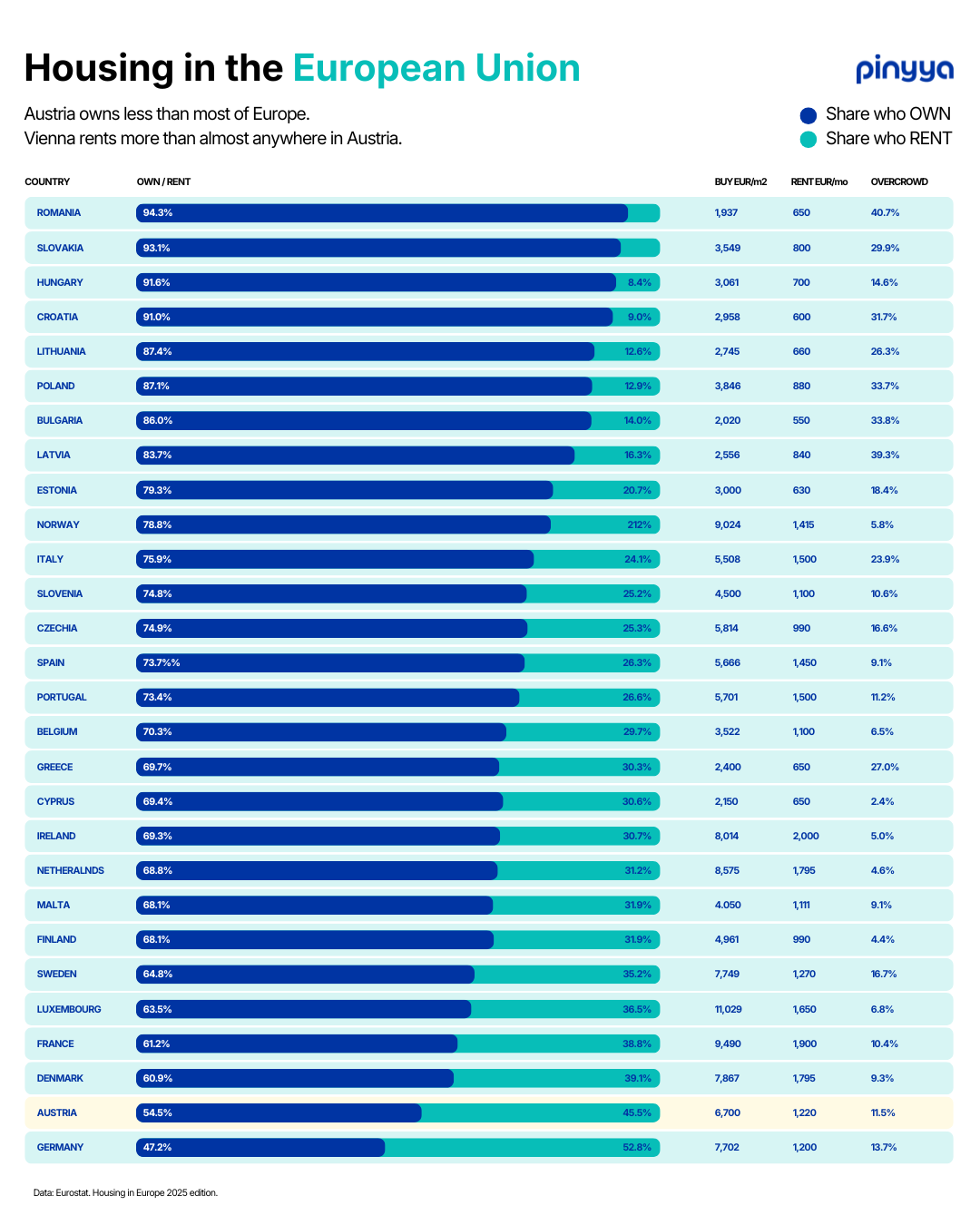
Eurostat’s “Housing in Europe - 2025 edition” compares three core housing indicators across European countries: the share of people who own, the share who rent, and the share living in overcrowded housing. When those numbers are lined up side by side, Austria stands out as a country where renting is much more common than in many neighbouring markets.
In countries such as Romania, Slovakia, Hungary and Croatia, more than 90% of people live in owner-occupied housing.
Austria looks very different. Just 54.5% of people in Austria live in homes they own, while 45.5% rent. That puts Austria well below the EU average for ownership and well above it for renting.
For people trying to move from renting to owning, that means they are doing so in a system where staying a tenant is common and where ownership is harder to reach than in much of the EU.
What the ownership gap tells us
The gap between Austria and the EU average is not just an abstract comparison. It helps explain why ownership can feel like a narrower path here, even for households with stable incomes and long-term plans.
In an average EU country, around two-thirds of people live in owner-occupied housing. In Austria, the balance is much closer, with nearly half the population renting instead.
That changes the market in several ways. A larger rental sector means more households are building their lives around leases rather than ownership. It also means fewer people are already benefiting from the long-term security and equity growth that ownership can bring.
The result is a housing system where renting is not a temporary stage for many people, but a long-term reality.
This is one reason Austria matters in a European housing discussion. It shows that affordability is not only about whether homes exist or whether prices are rising. It is also about whether the structure of the market gives enough people a realistic route into owning.
Prices in the capital
The same EU comparison also looks at capital-city housing costs, using indicative purchase prices per square metre and monthly rent levels. For Austria, the capital-city purchase figure used in the chart is €6,700 per square metre, based on pinyya’s previously published Vienna median. That places Austria above a number of Central and Eastern European capitals, while still below the most expensive capitals in Western and Northern Europe.
This matters because capital-city prices shape the ownership challenge in very practical terms. In a country where ownership is already below the EU average, a higher cost of buying in the capital raises the threshold even further. The entry point is simply harder to reach.
That does not mean Austria has the most expensive capital in Europe. It does mean that people trying to buy in and around the country’s main economic centre face a market where prices are high enough to reinforce the wider ownership gap. When a large share of the population is already renting, higher capital-city prices make it easier for renting to remain the default.
More than ownership alone
Ownership rates tell one part of the story. Overcrowding helps fill in the rest. Eurostat defines overcrowding by looking at whether a household has enough rooms for the number of people living in it, using a standard method across countries. This makes it possible to compare not only who owns and who rents, but also how comfortably people are housed.
In the table used for the chart, Austria’s overcrowding rate is 11.5%. That is much lower than in several high-ownership countries such as Romania, Bulgaria and Latvia, where overcrowding is significantly more common. It is also somewhat higher than in a number of wealthier Western and Northern European countries with very low overcrowding levels.
This combination is important. Austria does not sit among the countries with the most severe overcrowding problems. The bigger issue is that many people have housing, but fewer have ownership. That shifts the conversation away from space alone and toward stability, access and long-term control over where and how people live.
Why this matters for people who want to own
For aspiring homeowners, these numbers help explain why the path to ownership can feel so stretched. In Austria, moving from renting to owning means crossing a larger structural divide than in countries where ownership is already the norm. You are not just saving for a down payment. You are trying to move into the smaller half of the housing system.
That is why comparisons like this are useful. They show that difficulty entering ownership is not only a personal financial challenge. It is part of how the Austrian market is set up. Renting plays a bigger role here, and capital-city prices raise the bar even further.
Seen that way, the problem becomes clearer. The question is not simply why people are renting. The question is why more of them do not have a realistic way to start owning before they can afford full traditional ownership.
From all‑or‑nothing to step by step
The statistics show that 45.5% of people in Austria rent because the jump to ownership is still mostly all‑or‑nothing. You rent until you can bring a full deposit, secure a conventional mortgage and buy one property outright. If that step never quite lines up with your income, savings and life events, you stay on the renting side of the divide.
Aligned Ownership is designed to remove that all‑or‑nothing requirement. Instead of asking people to wait until they can afford the entire purchase in one move, it lets them start with a smaller share of a specific home and grow that share over time, within a regulated structure. The household commits to an agreed entry share and monthly payments linked to their stake. Investors provide the remaining capital and receive returns that are tied to the same property and the same long‑term outcome. As the household buys more over time, their ownership increases and the investor’s share reduces, making progress visible rather than binary.
Why this matters in an “own less” country
In a country where ownership is already high, this kind of model might be a marginal improvement. In Austria, where nearly half of people rent, it speaks directly to the gap the data highlights. The ownership statistics show how many households never make the jump because the traditional structure expects them to arrive at the finish line before they are allowed to start.
By giving people a way to begin owning earlier, even if full ownership still feels far away, Aligned Ownership offers a different way to read the same Eurostat chart. The 54.5% who own and the 45.5% who rent are no longer two fixed groups. There is a path that lets households move from one side to the other gradually and transparently.
A brief note for investors
For investors, the same structure reframes the choice between liquid but distant exposure and fully direct ownership. Instead of owning a generic slice of a listed vehicle or taking on the entire burden of a single property, investors can back specific homes in a framework where their returns are aligned with a household’s progress into ownership. That alignment matters more in markets like Austria, where access is the core issue and where the long‑term demand for housing is already visible in the rental statistics.
Taking the next step
Austria’s line in the EU housing data tells a clear story. The country owns less than much of Europe and rents more than much of Europe. That does not mean ownership is impossible. It means the route into it needs to be clearer, fairer and better suited to how people actually live now.
If you are part of that renting half and want to see what ownership could look like before a full traditional purchase is in reach, Aligned Ownership is one way to bridge that gap. It connects the realities shown in the data with a structure that lets you start owning step by step, rather than waiting for an all‑or‑nothing moment that may never arrive.
