



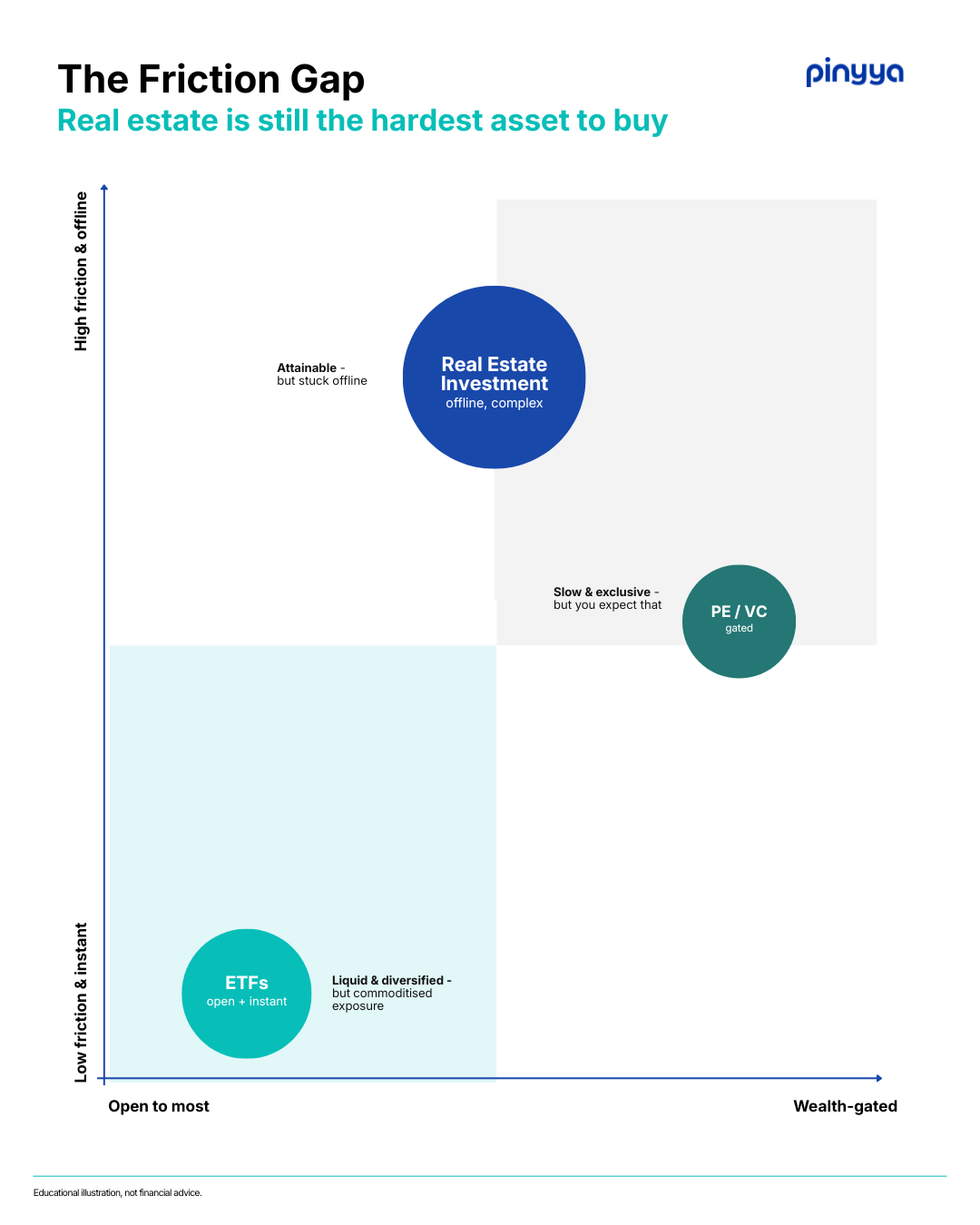
Most people can start investing in the stock market in a few clicks. Some can write a cheque into private funds if their wealth and network allow it. Yet when it comes to real estate, the asset that many people trust most, buying in is still one of the hardest moves to make. The friction gap chart below is designed to make that difference visible.
Two axes of friction
The chart uses two simple axes. The vertical axis shows how much friction there is and how offline the process tends to be. At the bottom, you have low friction and instant access. At the top, you have high friction and offline processes, with paperwork, appointments and multiple intermediaries.
The horizontal axis runs from “open to most” on the left to “wealth gated” on the right. Open assets are those that most people can access with small amounts and standard accounts. Wealth‑gated assets require higher minimum tickets, accreditation or specific relationships, so they are effectively reserved for a smaller group.
With those two axes in mind, the chart places three familiar categories: ETFs, private equity and venture capital, and traditional real estate investment.
ETFs: open and instant, but commoditised
In the bottom left corner sit exchange‑traded funds. They are “open and instant”, because most people can buy them through a broker account with relatively small minimums, and trades are executed quickly at market prices. ETFs offer diversified exposure to assets such as equities, bonds or even listed property companies, and they are one of the simplest ways to get investment exposure without large upfront capital.
The trade‑off is that exposure is commoditised. An ETF unit is a claim on a fund that owns a portfolio of securities, not a named home or a specific apartment. For someone who wants clear, direct ownership of a property, or who wants to see how their capital connects to a household’s path into ownership, ETFs can feel distant even while they are easy to use.
Private equity and venture capital: gated by wealth and access
On the right side of the chart, in the wealth‑gated area, sit private equity and venture capital. These assets are described as “slow and exclusive” and “gated”, which reflects how they typically work. Entry tickets are high, legal and regulatory frameworks restrict access to specific investor types, and capital is usually locked up for long periods.
Many investors accept that as part of the category. Private markets are expected to be selective, with lengthy due diligence, capital calls and long investment horizons. For households or smaller investors who want real estate exposure or to back specific projects, this corner of the chart usually remains out of reach.
Direct real estate: attainable, but stuck offline
The largest bubble on the chart is “Real estate investment”. It sits high on the friction axis and closer to the “open to most” side, with the label “offline, complex”. That placement reflects what regulators and central banks have been pointing to for years: in markets like Austria, direct property purchases require substantial down payments, long mortgage processes and strict lending standards under rules such as KIM‑V.
For many households, real estate is theoretically attainable. Banks will finance a portion of the purchase price if the buyer can bring enough equity, stay within debt‑service limits and accept a long-term commitment. In practice, the process remains highly manual. Buyers interact with agents, banks, lawyers and various authorities, and the timeline from first viewing to completion can be measured in months, not minutes.
This is the core of the friction gap. On one side, you have assets like ETFs that are almost entirely digital and open, but less connected to specific homes or households. On the other, you have direct real estate, which offers very tangible exposure, but with significant entry costs and operational complexity.
Why pinyya breaks that trade-off
Every asset on this chart forces a choice. Easy and detached, or tangible and painful. For decades those were your only options in real estate: buy a fund that has nothing to do with a real home, or take on the full weight of a property purchase; the deposit, the decade of debt, the months of paperwork.
pinyya exists because that trade-off was never a law of nature. It was just how the system worked.
We took the two things people actually want: the tangibility of owning a real, named home, and the accessibility of a modern financial platform, and built a structure that delivers both at once.
Here's what that means in practice. Your capital funds a share of a specific, independently valued apartment; a real property held in a regulated structure with transparent reporting, not a unit in a fund that owns a portfolio you'll never see.
An aspiring homeowner moves in and begins buying out your share over time. You hold tangible, named real estate exposure and a clear, contracted path to your return as their ownership grows.
That is the shift. Not "another property fund." A different route entirely, one that turns the two things that usually keep investors out of direct real estate, the size of the ticket and the operational weight of owning a home, into a clean, structured position you can actually take.
It's built inside the same rules that govern responsible lending in Austria: loan-to-value limits, debt-service safeguards, FMA-aligned oversight. The difference isn't that pinyya ignores the guardrails. It's that pinyya is the first model to give investors regulated, direct exposure to real homes in a structure that simply didn't exist before.
The opportunity for aspiring homeowners and investors
Look at the chart again and the size of the gap becomes obvious. In Austria, nearly half the population rents, not because they don't want to own, but because the only door into ownership is a door most people can't open in one step.
That is millions of people with stable incomes, sitting on the wrong side of a wall, paying rent that builds someone else's equity. Every month, that demand grows and stays unmet.
For people who want to own, pinyya changes the question. It's no longer "how many more years until I've saved enough?" It's "how much of a home can I start owning today?" You move from tenant to owner in the same market where staying a tenant used to be the only realistic option.
For investors, this is where it gets interesting. You get exposure to real, named homes; the tangibility the chart shows is almost impossible to access cleanly, without the operational weight of buying and managing property yourself. Regulated, transparent, tied to specific assets.
And because your returns are structured to grow as households build their ownership, your capital isn't extracting from the housing gap. It's closing it. You back the exact demand that the data proves is there, in a model where the household winning and the investor winning are the same event.
That is the rare part. Most housing capital profits by keeping people renting. pinyya profits by getting them out. Aligned incentives aren't a marketing line here; they're the mechanism.
The friction gap isn't a niche. It's the largest, most obviously underserved position on the entire chart. pinyya was built to own it.
Taking the next step
If you see yourself in this friction gap, either as someone who is renting and wants to start owning, or as an investor who wants more direct exposure to real homes, the next step is to understand how a structured model can work in practice.
If you feel stuck between liquid investments and the complexity of buying a home, the next step is to see what is actually possible with your own numbers. The pinyya calculator shows what you could start owning in Vienna with the down payment you have today, and how that compares to continuing to rent. Try the calculator here.
